Only 2,016 more to go...
Looking towards Brooklyn from the East River
Spans - Manhattan-Brooklyn, East River
Delancey Street, LES to Broadway, Williamsburg Brooklyn.
Construction on the bridge began in 1896, and the bridge opened on December 19, 1903. Leffert L. Buck was chief engineer and Henry Hornbostel was architect. It was the second bridge to span the East River in NYC and at the time it was constructed, it set the record for the longest suspension bridge span on Earth which it took from it's neighbor, the Brooklyn Bridge, which had held the title for 17 years.
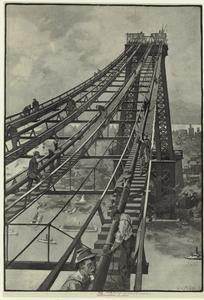
Wrapping Cables on the Williamsburg Bridge - From the NYPL Collection
"It is an unconventional structure, as suspension bridges go; though the main span hangs from cables in the usual manner, the side spans leading to the approaches are cantilevered, drawing no support from the cables above. The main span of the bridge is 1600 feet (488 m) long. The entire bridge is 7308 feet (2227 m) long between cable anchor terminals, and the deck is 118 feet (36 m) wide. The height at the center of the bridge is 135 feet (41 m) and each tower is 335 feet (102 m); these measurements taken from the river's surface at high water mark.
This bridge and the Manhattan Bridge are the only suspension bridges in New York City that still carry both automobile and rail traffic. In addition to this two-track rail line, connecting the New York City Subway's BMT Nassau Street Line and BMT Jamaica Line, there were once two sets of trolley tracks."
wikipedia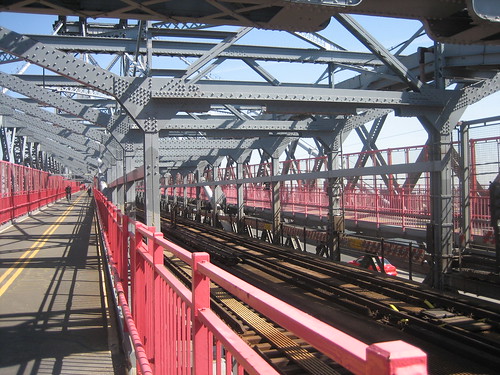
"For a brief period, the Long Island Rail Road (LIRR) ran passenger service along an elevated extension across the Williamsburg Bridge into Manhattan. The LIRR spur split from the existing Atlantic Avenue line northwest onto the Broadway elevated line (today's J, M and Z subway lines), crossed the Williamsburg Bridge, and continued south to Chambers Street.
The bridge not only served the traffic needs of a growing population, but also greatly affected migration patterns of ethnic groups. Before the bridge opened, first- and second-generation Irish and German settlers (who called the enclave "Kleine Deutschland") lived in the Williamsburg section of Brooklyn. When it opened, an influx of Jewish settlers from the overcrowded Lower East Side crossed the "Jews' Bridge" into Williamsburg. In turn, long-time residents moved out to Queens.
As early as 1964, The New York World-Telegram and Sun reported that the bridge had fallen in such a state of disrepair that rust rained down on pedestrians. The only fresh paint was the graffiti scrawled in by vandals. During the 1970's, the pedestrian walkways were closed after a maintenance worker was mugged while doing his job."
nyc roads.com
In the 1980's, the Bridge was in terrible condition after years of neglect and the City's near bankruptcy during the 1970's. It was closed completely for emergency repair work and for many years following was under constant renovation which impacted traffic in one direction or the other. Trains were re-routed and followed a strict speed limit when crossing the bridge. In 1999 service halted entirely to allow repairs on the center lanes of the bridge which carry train traffic.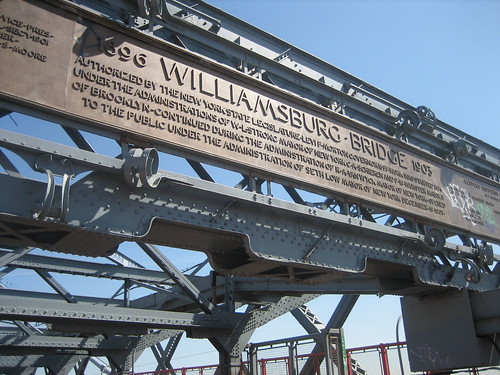
"The Williamsburg Bridge is one of the major crossings of the East River, carrying approximately 140,000 motorists, 92,000 subway/bus riders, 600 bikers and 500 pedestrians between the boroughs of Manhattan and Brooklyn and serving some of the busiest arteries in New York City."
NYCDOT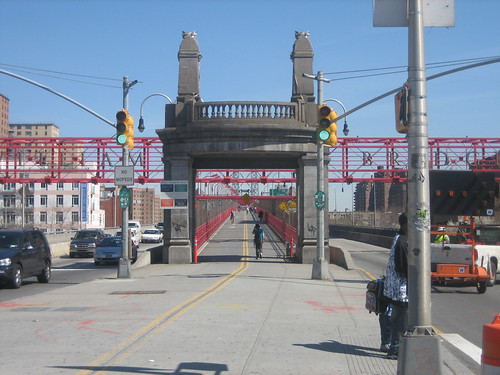
View of the Pedestrian and Bike Pathway Entrance on Delancey Street in Manhattan.
"The new footpath/bikeway has one common access point for pedestrians and cyclists in Manhattan at Clinton Street, which leads to a crossover before the main span of the bridge to enable people to access either the north or south paths. The north path is open to both pedestrians and bicyclists and leads to an access point at Washington Park in Brooklyn. The south path is dedicated to pedestrians an leads to an access point at Bedford Avenue. Completion of the new north walkway also means that, for the first time ever, the bridge is accessible to wheelchair users and meets the requirements of the Americans with Disabilities Act."
NYCDOT
One of my favorite little NY hidden gems is the fact that the pedestrian and bike paths end at Roebling Street on the Brooklyn side. That would be the street named after John A. Roebling, civil engineer and designer of the Brooklyn Bridge, which the Williamsburg Bridge superseded as the world's longest suspension bridge of it's time.
Type of bridge: Suspension
Construction started: November 7, 1896
Opened to traffic: December 19, 1903
Length of main span: 1,600 feet
Length of side spans: 300 feet
Length, anchorage to anchorage: 2,200 feet
Total length of bridge and approaches: 7,308 feet
Number of traffic lanes: 8 lanes
Number of subway tracks: 2 tracks
Height of towers above mean high water: 310 feet
Clearance at center above mean high water: 135 feet
Number of cables: 4 cables
Length of each of four cables: 2,985 feet
Diameter of each cable: 18¾ inches
Total length of wires: 17,500 miles
Weight of cables and suspenders: 4,344 tons
Structural material: Steel
Tower material: Steel
Deck material: Steel
Cost of original structure: $24,200,000
Bridge statistics from nyc roads.com
View Larger Map
Friday, April 11, 2008
The Williamsburg Bridge

Tuesday, September 18, 2007
Frequently Asked Questions
NYC Bridge Information from the DOT
Q: How many bridges are there in New York City? How many are under the jurisdiction of DOT?
A: There are 2,027 bridges in New York City. DOT's Division of Bridges is responsible for the design, construction, maintenance and operation of the 787 bridges (including 6 tunnels) and 67 culverts presently under the jurisdiction of the Department of Transportation.
Q: Who other than DOT operates bridges and tunnels in New York City?
A:MTA Bridges and Tunnels (formerly known as the Triborough Bridge and Tunnel Authority) operates the following structures: Bronx-Whitestone Bridge, Brooklyn-Battery Tunnel, Cross Bay Veterans Memorial Bridge, Henry Hudson Bridge, Marine Parkway-Gil Hodges Memorial Bridge, Queens Midtown Tunnel, Throgs Neck Bridge, Triborough Bridge, Verrazano-Narrows Bridge. The MetroNorth Railroad and the Long Island Railroad, both subsidiaries of the MTA, operate bridges and tunnels on their rail lines.
The Port Authority of New York and New Jersey operates the following bridges and tunnels: Bayonne Bridge, George Washington Bridge, Goethals Bridge, Holland Tunnel, Lincoln Tunnel, Outerbridge Crossing.
Q: Which bridge carries the largest amount of daily traffic?
A: The Queensboro Bridge. On an average weekday in 2004, some 180,369 vehicles crossed this celebrated cantilevered bridge between 59th Street in Manhattan and Long Island City in Queens. The Brooklyn Bridge had 137,563 vehicle crossings, the Williamsburg Bridge had 110,528 and the Manhattan Bridge had 79,129.
Q: How many New York City bridges are classified as historic landmarks?
A: As of January 1, 1998, ten bridges in New York City had been awarded some degree of landmark status. They include seven that are under the jurisdiction of the New York City Department of Transportation: the Brooklyn, Manhattan, Queensboro, Washington, University Heights, Carroll Street and Macombs Dam Bridges. The three landmarked bridges not operated by DOT are the George Washington Bridge (Port Authority of New York and New Jersey), Highbridge (NYC Department of Environmental Protection), and Hell Gate Bridge (Amtrak).
Q: What was the first bridge built in New York City? What is the oldest bridge still standing in New York City?
A: New York City’s first bridge, known as the King’s Bridge, was constructed in 1693. Fitted with stone abutments and a timber deck, it spanned Spuyten Duyvil Creek between Manhattan and the Bronx. It was demolished in 1917. The oldest bridge still standing in New York City is Highbridge, which spans the Harlem River between Manhattan and the Bronx; it was built in 1843. Highbridge is an aqueduct that carries a water main; it is not accessible to passengers or vehicles. The oldest bridge that is open to passengers or vehicles is the Brooklyn Bridge, which opened in 1883.
Q: When were the East River Bridges built? Which of the East River Bridges is the longest?
A: The four major bridges over the East River were constructed within four decades, from the start of construction on the Brooklyn Bridge in January 1870 to completion of the Manhattan Bridge in December 1909. The Brooklyn Bridge, one of New York City’s most celebrated architectural wonders and arguably the most influential bridge in American history, was completed in 1883. Designed by John Augustus Roebling and completed by his son Washington Roebling, the Brooklyn Bridge was, at the time of its completion, the longest suspension bridge in the world, with a main span of 1595.5 feet. The Williamsburg Bridge, with its 35-story steel towers, is the largest of the three suspension bridges that span the East River. When it was completed in 1903, it became the longest suspension bridge in the world, with a main span that is 1,600 feet long.
The two-decked Queensboro Bridge is one of the greatest cantilever bridges in the history of American bridge design. It was completed in March 1909. The last of the great bridges constructed across the East River, the Manhattan Bridge, opened on traffic on December 31, 1909.
Q: How many movable bridges does New York City operate?
A: There are 25 movable bridges in New York City, including two retractile bridges, seven swing bridges, four lift bridges, and twelve bascule (drawbridge) bridges.
Q: How many bridges connect Manhattan to other Boroughs or States?
A: There are 21 major bridges that connect to the island of Manhattan.
Manhattan Only - In order from West to East
(The Hudson to the Harlem to the East Rivers) and North to South.
George Washington Bridge
Spuyten Duyvil Rail Bridge
Henry Hudson Bridge
Broadway Bridge
University Heights Bridge
Washington Bridge
Alexander Hamilton Bridge
Highbridge
Macombs Dam Bridge
145th Street Bridge
Madison Avenue Bridge
Park Avenue Bridge
Third Avenue Bridge
Willis Avenue Bridge
Triborough Bridge
Wards Island Pedestrian Bridge
Roosevelt Island Bridge
Queensboro Bridge
Williamsburg Bridge
Manhattan Bridge
Brooklyn Bridge
View Larger Map