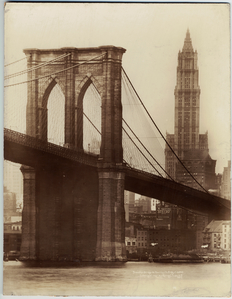
Changing New York: Photographs by Berenice Abbott, 1935-1938
From the NYPL Digitial Collection
The Brooklyn Bridge as seen by Berenice Abbott in 1936.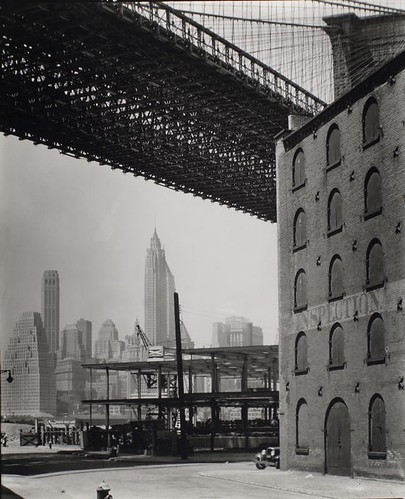
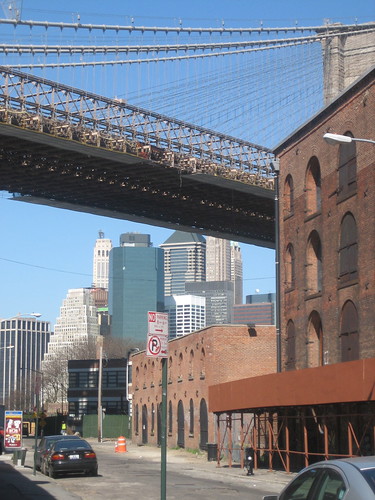
The Brooklyn Bridge photographed from Water Street in 2008
"Photographer Berenice Abbott proposed Changing New York, her grand project to document New York City, to the Federal Art Project (FAP) in 1935. The FAP was a Depression-era government program for unemployed artists and workers in related fields such as advertising, graphic design, illustration, photofinishing, and publishing. A changing staff of more than a dozen participated as darkroom printers, field assistants, researchers and clerks on this and other photographic efforts. Abbott's efforts resulted in a book in 1939, in advance of the World's Fair in Flushing Meadow NY, with 97 illustrations and text by Abbott's fellow WPA employee (and life companion), art critic Elizabeth McCausland (1899-1965). At the project's conclusion, the FAP distributed complete sets of Abbott's final 302 images to high schools, libraries and other public institutions in the metropolitan area, plus the State Library in Albany.
Abbott was born and raised in Ohio where she endured an erratic family life. In 1918, after two semesters at Ohio State University, she left to join friends associated with the Provincetown Players, in Greenwich Village. There she met Djuna Barnes, Kenneth Burke, Elsa von Freytag-Loringhoven, Edna St. Vincent Millay, Little Review editors Margaret Anderson and Jane Heap, and other influential modernists. From 1919-1921, while studying sculpture, Abbott supported herself as an artist's model, posing for photographers Nikolas Muray and Man Ray. She also met Marcel Duchamp, and participated in Dadaist publications.
Abbott moved to Paris in 1921, where she continued to study sculpture (and in Berlin), and to support herself by modeling. During 1923-1926, she worked as Man Ray's darkroom assistant (he had also relocated to Paris) and tried portrait photography at his suggestion. Abbott's first solo exhibition, in 1926, launched her career. In 1928 she rescued and began to promote Eugène Atget's photographic work, calling his thirty years of Parisian streetscapes and related studies "realism unadorned. "
In 1929 Abbott took a new artistic direction to tackle the scope (if not the scale) of Atget's achievement in New York City. During 1929-38, she photographed urban material culture and the built environment of New York, documenting the old before it was torn down and recording new construction. From 1934-58, she also taught photography at the New School. During 1935-39, Abbott worked as a "supervisor" for the Federal Art Project to create Changing New York (her free-lance work and New School teaching commitment made her ineligible for unemployment relief) .
1970 saw Abbott's first major retrospective exhibition, at the Museum of Modern Art. Her first retrospective portfolio appeared in 1976, and she received the International Center of Photography's Lifetime Achievement Award in 1989. She died at home in Monson, Maine in December 1991."
Quoted from The NYPL Digital Gallery
For a non bridge specific view of Abbott's work, see both the original, Berenice Abbott: Changing New York and Douglas Lefevre's New York Changing: Revisiting Berenice Abbott's New York
Tuesday, April 15, 2008
Berenice Abbott

Wednesday, September 19, 2007
The Brooklyn Bridge
2,026 to go...
No other bridge could be Number 1 on the list.
Span - Manhattan to Brooklyn across the East River
The Brooklyn Bridge, one of New York City’s most celebrated architectural wonders and arguably the most influential bridge in American history, was completed in 1883. Designed by John Augustus Roebling and completed by his son Washington Roebling, the Brooklyn Bridge was, at the time of its completion, the longest suspension bridge in the world, with a main span of 1595.5 feet.
It received landmark status in 1964 and is the oldest bridge that is open to passengers or vehicles.
The Brooklyn Bridge had 137,563 vehicle crossings on an average weekday in 2004.
Quoted from: Transportation Alternatives, The DOT, and
the Wikipedia entry for The Brooklyn Bridge
Pedestrian and Bicycle access to the Brooklyn Bridge -
Access to the bridge has improved markedly over the last few years.
The city recently added much needed signs and lighting to the Cadman Plaza Stairway entrance that is heavily used by tourists and pedestrians.
Last year, they added a two-way protected bike lane on Tillary Street to facilitate access to the bridge from the Downtown and Heights neighborhoods.
The Adams Street bike path is still basically unusable due to the fact that the Marriott allows livery cab drivers to park all along the length in front of the hotel.
The Manhattan entrance is easy to find, but hard to legally ride to on a bicycle. The safest thing to do is dismount and walk from the corner of Centre and Chambers Streets to the pedestrian entrance, due to traffic and crowds, but very few cyclists do this.
The pathway across the bridge is separated into two distinct lanes; the southern lane is for pedestrians, the northern lane for cyclists. These are clearly marked with icons, but are largely ignored by tourists who don't know any better.
Manhattan entrance: Park Row and Centre Street, across from City Hall Park.
Brooklyn entrance: Stairs under the overpass at Cadman Plaza East and Prospect Streets, or ramp to Tillary and Adams Streets.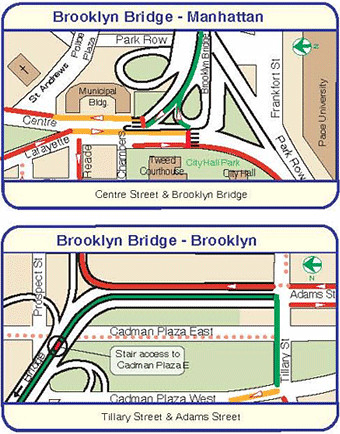
Cyclists at dawn crossing the Brooklyn Bridge during the 2007 NYC Century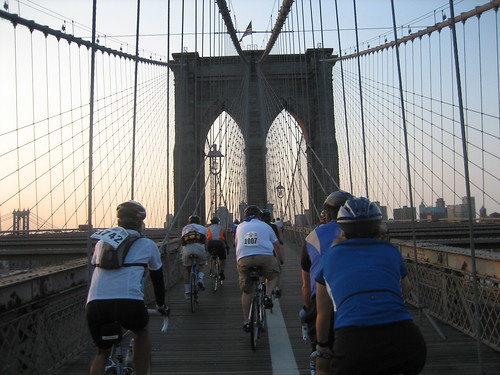
Sunrise over the Manhattan Bridge from the pedestrian walkway of the Brooklyn Bridge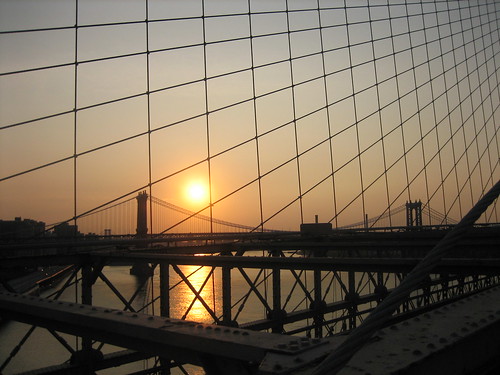
Type of bridge:Suspension
Construction started:January 3, 1870
Opened to traffic:May 24, 1883
Length of main span:1,595 feet, 6 inches
Length of side spans:930 feet
Length, anchorage to anchorage:3,455 feet, 6 inches
Total length of bridge and approaches:6,016 feet
Width of bridge:85 feet
Number of traffic lanes:6 lanes
Number of cables:4 cables
Height of towers above mean high water:276 feet, 6 inches
Clearance at center above mean high water:135 feet
Length of each of four cables:3,578 feet, 6 inches
Diameter of each cable:15¾ inches
Number of wires in each cable:5,434 wires
Total length of wires:14,060 miles
Total masonry in towers:85,159 cubic yards
Weight of suspended structure:6,620 tons
Total weight of bridge:14,680 tons
Cost of original structure:$15,100,000
Bridge facts from NYCRoads.com
View Larger Map