Only 2,017 more to go...
Spans - The Gowanus Canal, Brooklyn
According to the DOT,
"The Union Street Bridge is a double leaf Scherzer rolling lift bascule supporting Union Street over the Gowanus Canal in the borough of Brooklyn."
The Union Street Bridge is the northernmost of five bridges which cross the Gowanus Canal in Brooklyn. The other four bridges are, from north to south; The Carroll Street Bridge, The Third Street Bridge, The Ninth Street Bridge, and the Hamilton Avenue Drawbridge which runs parallel to the Gowanus Expressway at the mouth of the canal.
The Bridge looks like a continuation of Union Street until you are right up on top of the steel grid span and can see the canal on either side.
It has two traffic lanes and two sidewalks.
Union Street is one way traveling eastbound across the span, but bicyclists ignore this constantly because Union Street runs in both directions straight from Prospect Park until 4th Avenue.

Looking North to Butler Street.
Looking South to the Carroll Street Bridge.
According to the EPA, the bridge was opened for water traffic 245 times in 1999 (the last year I could find available data.)
Type of Bridge: Bascule
Opened to traffic: 1905
Roadway Width: 35 feet
Sidewalks: Two 6 foot wide sidewalks
Max. Span: 56 Feet
Construction Cost: $85,206.85
2 general lanes and 1 bicycle lane on 1 roadway allow eastbound ONE-WAY traffic only.
2 sidewalks
Bridge facts from NYCDOT
View Larger Map
Tuesday, February 19, 2008
The Union Street Bridge

Saturday, December 15, 2007
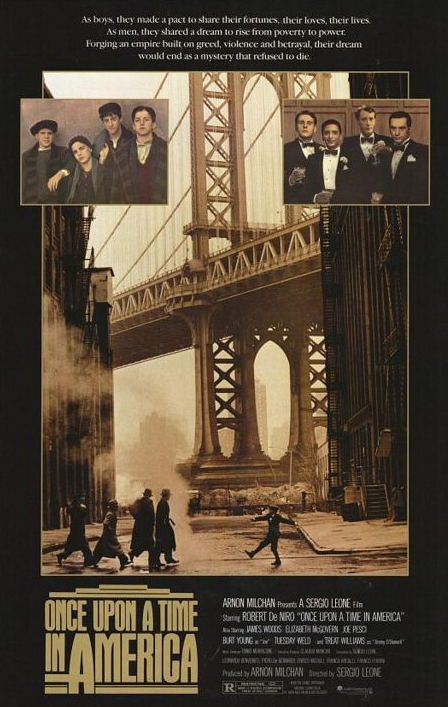
Manhattan Bridge in the Movies
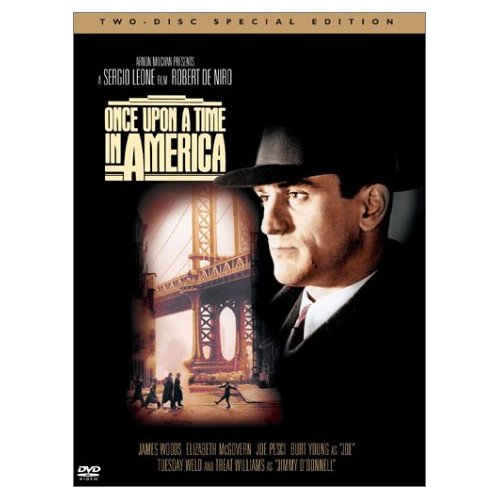
This iconic image is from Sergio Leone's classic 1984 film "Once Upon A Time In America", which starred Robert DeNiro.
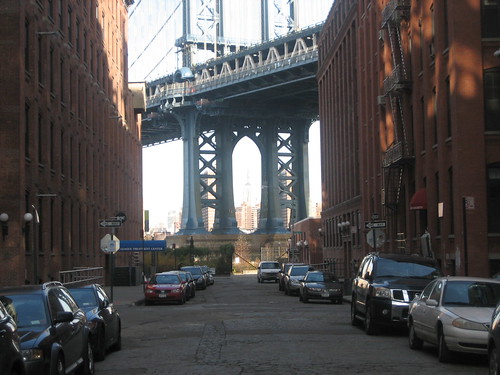
The view down Washington Street in Brooklyn's DUMBO remains largely unchanged to this day - minus the debris.
The Empire State Building is visible through the uprights of the bridge if you move slightly to your left in the street, and often the street is closed for film and music video shoots.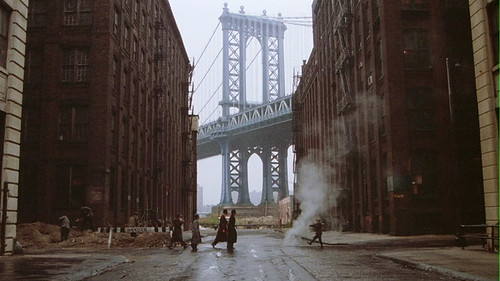
Thursday, November 29, 2007
The Carroll Street Bridge
Only 2,018 more to go...
The Carroll Street Bridge in Brooklyn is one of five bridges which span the Gowanus Canal. The canal has long been considered the dividing line between the Carroll Gardens and Park Slope neighborhoods although it is sometimes now referred to as it's own community - 'Gowanus'.
The five bridges are some of the most picturesque in the city and are, in order from North to South, The Union Street Bridge, The Carroll Street Bridge, The Third Street Bridge, The Ninth Street Bridge, and the Hamilton Avenue Drawbridge which runs parallel to the Gowanus Expressway at the mouth of the canal.
The Carroll Street Bridge was built in 1888 and is the oldest of only four retractile bridges in the United States. It rolls back horizontally on wheels set on steel rails in order to clear the waterway. The bridge was designated a NYC landmark in 1987.
View of the pulley and cable retraction system.
According to the EPA, the bridge was opened for water traffic 228 times in 1999 (the last year I could find available data.)
The approach is still cobblestoned and the bridge itself is wooden planking. One of the better unnoticed details is the sign which remains atop the structure:
"Ordinance of the City
Any Person Driving over
this Bridge Faster than
a Walk will be Subject to
a Penalty of Five Dollars
for Each Offence."
(Caps are theirs)
Type of Bridge: Retractile
Opened to traffic: 1889
Roadway Width: 17 feet
Sidewalks: Two 4.5 foot wide sidewalks
View Larger Map
Saturday, November 17, 2007
The Manhattan Bridge - Update
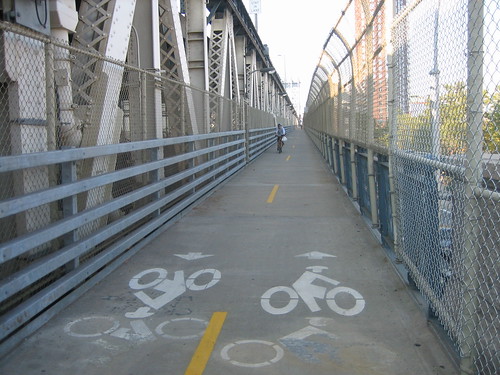
Oooh - Sexy!
Yes, It's the bicycle specific, newly opened, bike lane on the Manhattan Bridge.
Check it out. Bike icons in both lanes.
Of course, I did see about 5 people on foot on the North Path, but who cares.
The approach on both sides is suicidal and takes you through some of the worst streets to cycle on, but it's so nice to ride across the river without fear of hitting or being hit by random tourists, kids, sightseers or joggers on the Brooklyn Bridge Footpath.
On the Manhattan side, the bike path entrance is at Chrystie Street on the left hand (North) side when facing the bridge from Canal Street.
The Brooklyn entrance to the path is a lovely new ramp at Jay and Sands Streets.
The approach to this is also crazy if you aren't used to riding in traffic - and hard to find if you don't know exactly where it is.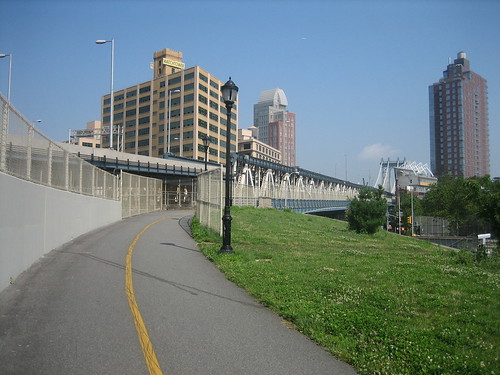
The stairs to the pedestrian path are on the Jay Street side and the ramp is on the Sands Street side.
The intersection of Jay and Sands is right in the middle of the traffic pattern leading from the BQE to both the Brooklyn and Manhattan Bridges, so you need to be alert, but if you are coming from Downtown Brooklyn the Adams Street approach (AKA Brooklyn Bridge Blvd) is completely empty of car traffic.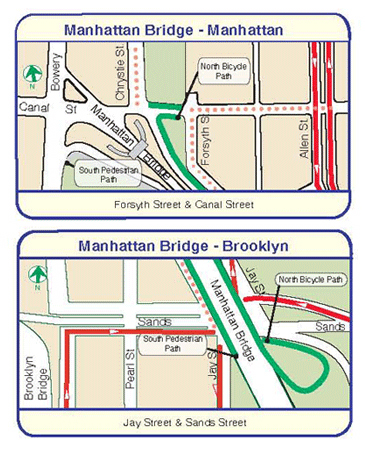
Sunday, November 4, 2007
The George Washington Bridge
Only 2,019 more to go...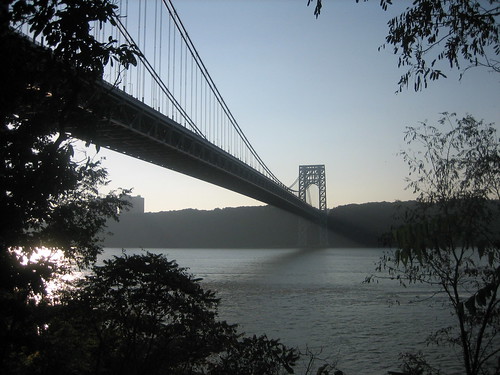
The George Washington Bridge seen from Washington Heights, looking across the Hudson River to the Englewood Cliffs.
Spans - New York-New Jersey, The Hudson River.
The George Washington Bridge is a toll suspension bridge spanning the Hudson River, connecting the Washington Heights neighborhood in the borough of Manhattan in New York City to Fort Lee in New Jersey by means of Interstate 95, U.S. Route 1/9. U.S. Route 46, which is entirely in New Jersey, ends halfway across the bridge at the state border. The GW is considered one of the world's busiest bridges in terms of vehicle traffic; In 2004, the bridge carried 108,404,000 vehicles, with current estimates of nearly 300,000 vehicles daily.
When it opened, the bridge had the longest main span in the world; at 1,067 m (3,500 ft), it nearly doubled the previous record of 564 m (1,850 ft), which had been held by the Ambassador Bridge.
The GW span is currently the fourth largest suspension bridge in the United States.
The bridge contains two levels, an upper level with four lanes in each direction and a lower level with three lanes in each direction, for a total of 14 lanes of travel. Additionally, the bridge houses a path on each side of the bridge for pedestrian traffic.
Groundbreaking for the new bridge began in October 1927. Its chief engineer was Othmar Ammann, with Cass Gilbert as architect. The bridge was dedicated on October 24, 1931, and opened to traffic the following day. Initially named the "Hudson River Bridge," the bridge is named in honor of George Washington, the first President of the United States. The Bridge is near the sites of Fort Washington (on the New York side) and Fort Lee (in New Jersey), which were fortified positions used by General Washington and his American forces in his unsuccessful attempt to deter the British occupation of New York City in 1776 during the American Revolutionary War.
Bridge facts from the wikipedia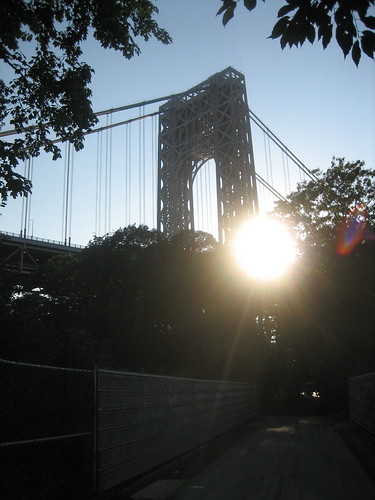
Modernist, Le Corbusier, said of the structure, "The George Washington Bridge over the Hudson is the most beautiful bridge in the world. Made of cables and steel beams, it gleams in the sky like a reversed arch. It is blessed. It is the only seat of grace in the disordered city. It is painted an aluminum color and, between water and sky, you see nothing but the bent cord supported by two steel towers. When your car moves up the ramp the two towers rise so high that it brings you happiness; their structure is so pure, so resolute, so regular that here, finally, steel architecture seems to laugh. The car reaches an unexpectedly wide apron; the second tower is very far away; innumerable vertical cables, gleaming against the sky, are suspended from the magisterial curve which swings down and then up. The rose-colored towers of New York appear, a vision whose harshness is mitigated by distance." (When the Cathedrals were White", 1947.)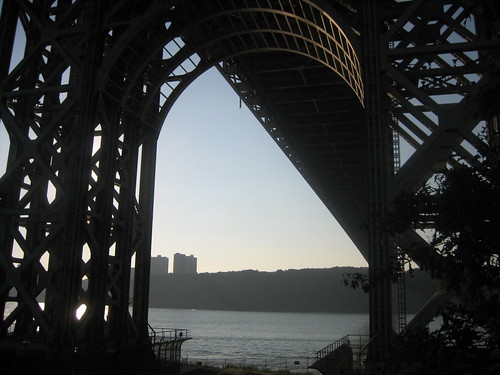
The bicycle and pedestrian pathway is accessible from 178th street, though the entrance to the ramp is so obscurely hidden that many people wander in circles, lost in the tangle of on-ramps and one-way streets.
The ramp itself is acutely curved and barely wide enough for two people, much less two cyclists. Once on the bridge, the pathway is fairly tight in places, narrowing through the towers into single lane, blind turns.
The path can be harrowing in high winds.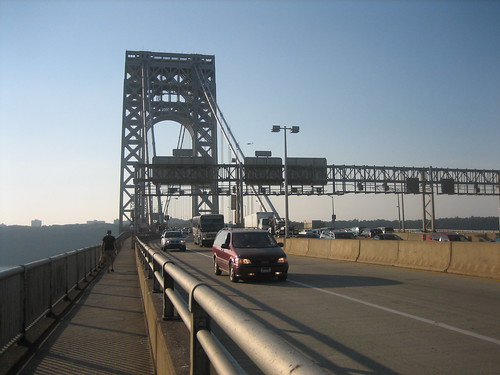
The view from the center of the span is one of the most spectacular in the world.
Commanding a view of the lower Hudson, Manhattan, and the Palisades, it rewards those hardy souls who make the trip.
The bridge is a common starting place for cyclists who make their way up the NJ side of the Hudson for training rides.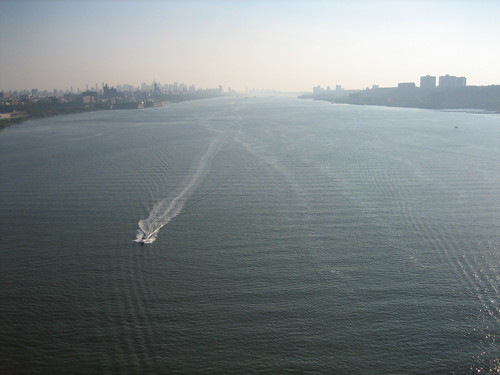
Looking down and to the left, the 'Little Red Lighthouse' that used to guard ships from running aground on the rocky point is still holding vigil - although now dwarfed by the span above it.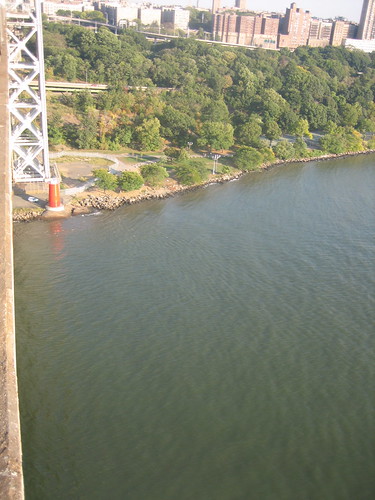
Type of bridge: Suspension
Construction started: October 21, 1927
Opened to traffic (upper deck): October 25, 1931
Opened to traffic (lower deck): August 29, 1962
Length of main span: 3,500 feet
Length, anchorage to anchorage: 4,760 feet
Width of bridge: 119 feet
Number of traffic lanes: 14 lanes (8 upper, 6 lower)
Height of tower above mean high water: 604 feet
Clearance at mid-span above mean high water: 213 feet
Cost of original structure: $59,000,000
Bridge statistics from nycroads.com
View Larger Map