There are 2,027 bridges in NYC.
              I'm trying find all of them.
                         And then cross all of them.

Saturday, July 12, 2008

The Grand Street Bridge

Only 2,012 more to go ...

IMG_3227

The Grand Street Bridge
Spans - Brooklyn to Queens over the East Branch of the Newtown Creek (Possibly AKA the English Kills?)
From Gardner Avenue in Brooklyn to 47th Street in Queens

IMG_3231

Grand Street is a two-lane local City street in Queens and Kings Counties. Grand Street runs northeast and extends from the Brooklyn Queens Expressway in Brooklyn to Queens Boulevard in Queens.
The road is known as Grand Street west of the bridge and Grand Avenue east of the bridge.
The Grand Street Bridge is a 69.2m long swing type bridge with a steel truss superstructure.

IMG_3228

The general appearance of the bridge remains the same as when it was opened in 1903. The bridge provides a channel with a horizontal clearance of 17.7m and a vertical clearance, in the closed position, of 3.0m at Median High Water and 4.6m at Median Low Water.

IMG_3240

The bridge structure carries a two-lane two-way vehicular roadway with sidewalks on either side. The roadway width on the bridge is 6.0m and the sidewalks are 1.8m wide. The height restriction is 4.1m.
The approach roadways are wider than the bridge roadway. For example, the width of Grand Avenue at the east approach to the bridge (near 47th Street) is 15.11m.

Bridge facts from NYC DOT

IMG_3234

The Grand Street Bridge is one of five (need to fact check this as of 07/08) bridges which connect Brooklyn to Queens across the Newtown Creek and it's branches, Maspeth Creek and The English Kills.
Those Bridges are:
The Pulaski Bridge
The Greenpoint Avenue/JJ Byrne Memorial Bridge
The Kosciuszko Bridge
The Grand Street Bridge
and the Metropolitan Avenue Bridge

"The Newtown Creek is a murky estuary that runs 3 1/2 industrialized miles along the border of Greenpoint, Brooklyn and Maspeth, Queens. Once a site of mansions, then a mecca for shipbuilders, the creek is now a toxic dumping ground that bubbles up raw sewage every time it rains. Newtown Creek has been given the lowest possible cleanliness rating by both New York City and New York State. The Riverkeeper, wrote of the creek:

"It fails to meet even the most basic goals of the 1972 Clean Water Act. Nearly the entire stretch of the creek is heavily industrialized, there is virtually no public access, and water dependent industries have stagnated. A boat trip up the creek is a journey into the heart of darkness, with the backdrop of the Manhattan skyline as a reminder of its real world locale."

pbs.org

Pedestrian and Bicycle Access:
There is a pedestrian pathway on this bridge, but I don't recommend cycling on it.
Most cyclists merge into traffic and cross the metal grating because the Brooklyn side of the path is a completely demolished, uneven dirt path and stairs.


IMG_3235 IMG_3241


Random Bridge Factoids:
The Grand Street Bridge looks very similar in character and design to the Carroll Street Bridge which was completed in 1889. Unfortunately, this bridge hasn't received as much love over the years and it shows.

The Newtown Creek has a long history of tragedy:

* January 1894: At least four workers dredging the creek died after a flimsy foot bridge they were standing upon collapsed.
* July 1894: Two boys, apparently brothers, drowned after they evidently got caught in the “ooze and slime” at the bottom of the creek, which is composed of soft sediment.
* January 1896: A Polish priest of the Roman Catholic Church fell into the creek and drowned.
* June 1910: A boy, roughly age 12, drowned in the creek at the foot of Ten Eyck Street in Williamsburg, Brooklyn. His clothing was found nearby.
* February 1928: A 29-year-old worker was killed when a 325-ton draw span was moved upstream to make way for a new bridge.
* January 1934: Two men drowned after their car plunged into the creek from the Penny Bridge, linking Greenpoint, Brooklyn, and Long Island City, Queens.
* November 1942: A 28-year-old diver drowned in the creek off Review Avenue in Long Island City “when his diving helmet became detached in an undetermined manner while he was searching for a link in an oil pipe crossing the creek,” The Times reported.
NYTimes
DrownedNewtown

January 26, 1896, New York Times

"The unguarded condition of Newtown Creek at the Grand Street Bridge, was responsible for another drowning accident early yesterday morning. The victim was a tall, heavily built man, who, from papers found in his pockets, is supposed to be the Rev. Leonard Syczek, a Polish priest of the Roman Catholic Church."

Borough: Brooklyn/Queens
Type: Swing
Waterway: Newtown Creek
Miles from Mouth: 3.1
Length: 555'
Max. Span: 227
Roadways: 1 - 19' 7"
Sidewalks: 2 - 6' 0"
Construction Cost: $191,008.19
Land Cost: $14,663.53
Total Cost: $205,671.72
Date Opened: Feb. 3, 1903

In 1998 (the last year I could find data for) it opened 86 times both for testing and water traffic


View Larger Map

Friday, June 27, 2008

The Hamilton Avenue Bridge

Only 2,013 more to go ...

IMG_3068

The Hamilton Avenue Bridge in Brooklyn is one of five bridges which span the Gowanus Canal.

The five bridges are, in order from North to South, The Union Street Bridge, The Carroll Street Bridge, The Third Street Bridge, The Ninth Street Bridge, and the Hamilton Avenue Drawbridge which runs parallel to the Gowanus Expressway at the mouth of the canal.

Most of the length of Hamilton Avenue runs below the elevated portion of the Gowanus Expressway, including the bridge. The bridge connects Smith Street and Second Avenue over the Gowanus Canal and is the first canal crossing north of the Gowanus Bay.

IMG_3062

"The bridge is comprised of two bridges, each consisting of one bascule span with each span carrying four lanes of one-way traffic (one northbound and one southbound) and a pedestrian sidewalk. Hardesty & Hanover LLP (as Waddell & Hardesty) designed the existing bridges based on the patented Hanover skew design—an innovative approach to skewed bascule crossings. The Hamilton Avenue Bridge is one of the two remaining structures of this type."

Source: Hardesty & Hanover LLP September 13, 2007


The Bridge is currently undergoing reconstruction.
The reconstruction will replace the entire bridge in two stages. Completion is scheduled for January 2009.

On June 28, 2008 at 12:01 am the entire southbound bridge will be taken out of service. The current 4-lane northbound bridge will be converted to 2 lanes northbound and 2 lanes southbound to facilitate the replacement of the southbound bridge.

IMG_3059

The Hamilton Avenue Bridge has a vertical clearance of 19 feet at
mean high water, and 23 feet at mean low water in the closed position.
The existing drawbridge operating regulations require the bridge to open on signal at all times.

IMG_3060

Want to get the bridge open?

Drawbridge Operation Regulations; Gowanus Canal, Brooklyn, NY

AGENCY: Coast Guard, DHS.

The draw of the Hamilton Avenue Bridge, mile 1.2, shall open on
signal after at least a four-hour advance notice is given by calling
(201) 400-5243. This paragraph is effective from November 7, 2007 to
January 15, 2009.

Type of Bridge: Bascule
Opened to traffic: 1942
Length of largest span: 77.8 ft.
Total length: 136.8 ft.
Deck width: 42.0 ft.
Vertical clearance above deck: 16.1 ft.
Average daily traffic: 23,187 (as of 2004)


View Larger Map

Wednesday, June 4, 2008

The Queensboro Bridge

Only 2,014 more to go...

IMG_2917

The Queensboro, AKA 59th Street Bridge

Spans - The East River, East and West Channel
From Midtown Manhattan East, across Roosevelt Island, to Queensbridge, Queens

IMG_1962

Open to traffic - March 30, 1909
No Toll
Manhattan to Roosevelt Island span length: 1,182 ft (360 m)
Roosevelt Island span length: 630 ft (192 m)
Roosevelt Island to Queens span length: 984 ft (300 m)
side span lengths: 469 and 459 ft (143 and 140 m)
total length between anchorages: 3724 ft (1135 m)
total length including approaches: 7449 ft (2270 m)


"Originally christened Blackwell’s Island Bridge, and intended to link Manhattan’s Harlem Line with the Long Island Railroad, the colossal, two-decked Queensboro Bridge is one of the greatest cantilever bridges in the history of American bridge design.
A collaboration between the famed bridge engineer Gustav Lindenthal (1850-1935) and architect Henry Hornbostel, the Queensboro’s massive, silver-painted trusses span the East River between 59th Street in Manhattan and Long Island City in Queens and offer spectacular views of midtown Manhattan, highlighted by the Empire State Building, the Chrysler Building, and the United Nations. Often referred to as the 59th Street Bridge, the Queensboro’s completion preceded that of the Manhattan Bridge by nine months."
NYCDOT

IMG_2913
View from 59th Street in Manhattan

The Beaux-Arts style bridge was given landmark status in 1974, one of only ten such designations in NYC.

IMG_1972
View from Roosevelt Island

IMG_1967

The bridge has been immortalized by numerous artists and musicians, including Simon & Garfunkel in their hit song, "The 59th Street Bridge Song/Feelin’ Groovy."
It has also served as a famous backdrop, denoting the wealth and luxury of an East Side, Sutton Place address in movies such as "The Tender Trap" where it is prominently visible through the windows of Frank Sinatra's bachelor pad.
More recently, the Green Goblin forced a showdown with Spiderman at the bridge by dangling ladylove, MaryJane from one of the supports while simultaneously threatening the passengers of the Roosevelt Island tramway.

IMG_2920

Pedestrian and Bicycle access to the Queensboro Bridge -
"The North Outer Roadway is open for the exclusive use of bicyclists and pedestrians 24 hours a day, seven days a week. The path connects Long Island City with Midtown Manhattan. T.A. worked for nearly twenty years to see this permanent route established. Nicknamed "The People's Roadway," the path's temporary closures in the 1980s and 1990s became a potent symbol of government indifference to bicyclists and walkers. Today, the path is a heavily used bike commuter route, though the existing Manhattan approach forces cyclists exiting to the south to make a dangerous three-block detour in order to reach Second Avenue." - TransAlt.org

Manhattan entrance: 60th Street, between Second and First Avenues
Queens entrance: Queens Plaza and Crescent Street

QueensboroTransAlt

Map from Fiboro Bridges

Other bridge factoids -
You can walk out of the front door of Scores on the Manhattan side, straight onto the pedestrian walkway, across to LIC, Queens and into Scandals - if a walking tour of NYC strip clubs is your idea of fun.
Until 1970, an industrial sized elevator connected Roosevelt Island with the bridge. It was big enough to carry vehicles and a proposal is now on the table to revisit the idea. Due to increased security in post - 9/11 NYC, water traffic is often re-routed away from the United Nations to the East Channel of the river. The passing ships require that the Roosevelt Island drawbridge be raised, cutting the island off to vehicles.
In an article published Feb, 4 1909, the New York Times reported that 235 people had applied for permission to be the first to jump off the soon to be completed bridge. Some were professional divers, other parachutists, a few were just desperate, but in the end they were all denied.
"The Celebration Committee announces that no bridge jumping will be allowed."


Type of bridge: Cantilever (multi-span)
Construction started: July 19, 1901
Opened to traffic: March 30, 1909
Length of western main span: 1,182 feet
Length of eastern main span: 984 feet
Length of bridge between anchorages: 3,724 feet, 6 inches
Total length of bridge and approaches: 7,449 feet
Width of bridge: 100 feet
Number of decks: 2 decks
Number of traffic lanes: 9 lanes (4 upper, 5 lower)
Height of towers above mean high water: 350 feet
Clearance at center above mean high water: 130 feet
Total structural steel used on bridge: 50,000 tons
Cost of original structure: $20,000,000

Bridge facts from NYC Roads.com


View Larger Map
Monday, May 19, 2008

Happy Birthday Brooklyn Bridge

IMG_2943

The Brooklyn Bridge turns One Hundred and Twenty Five this weekend
- and we're all invited.

IMG_2039

When the bridge opened on May 24 1883, it was, in the words of it's creator, John A. Roebling,
“... not only be the greatest bridge in existence, but it will be the greatest engineering work of the continent, and of the age.”


NYPL02
Print from the NYPL digital gallery

The 125th birthday of the Brooklyn Bridge begins with a party on Thursday, May 22 and continues through May 26.
The Brooklyn Philharmonic will play, the Grucci Bros. will once again illuminate the night with one of their world-renowned firework exhibitions (they were responsible for the 100th anniversary display as well), and the Bridge will show off it's celebratory new string of lights.

“The Brooklyn Bridge is not only one of the great engineering marvels of all time; it is also a beautiful symbol of New York that is recognized around the world,” said Mayor Bloomberg. “The wonderfully diverse events are representative of the iconic bridge that has connected the people of Brooklyn and Manhattan for generations. This is a wonderful opportunity to celebrate this legendary icon that has done so much for our City.”

IMG_2944

In honor of the occasion, the Bridge is undergoing a long-needed face-lift.
A new pedestrian entrance in DUMBO, with better signs (actually any signs at all are a bonus), new sidewalks, and fancy lighting under the overpass are all being hurried to completion before the party.

IMG_2945

IMG_2950

On Fulton Ferry Pier, a fabulously magical installation called "the Telectroscope" will let passing New Yorkers and Londoners commune via the transatlantic tunnel. See the amazingness here.

And the list just keeps going...

Anniversary events include; Free Films, Live Music, The Tour de Brooklyn, a Lecture Series, DJs, Walking Tours...

For a comprehensive list, go to: NYCVisit.com or NYCGOV.com

NYPLBB01

Saturday, April 26, 2008

Marine Parkway Gil Hodges Memorial Bridge

Only 2,015 more to go...

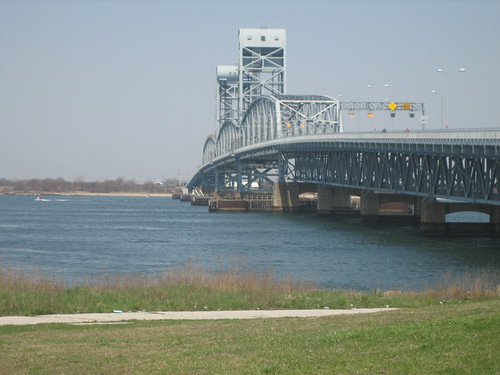
IMG_2792

As seen from the Rockaway Peninsula.

Spans: Brooklyn to Queens, The Rockaway Inlet of Jamaica Bay

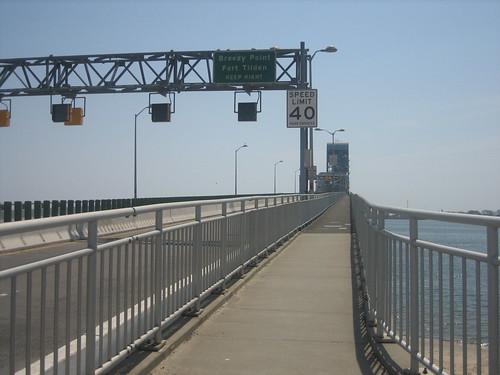
The Marine Parkway-Gil Hodges Memorial Bridge is a vertical lift bridge that crosses the Rockaway Inlet of Jamaica Bay, connecting the Rockaway Peninsula in Queens with Floyd Bennett Field in Brooklyn. It is one of very few toll bridge in NYC, and carries four motor traffic lanes and a (free) 5’ wide foot/cyclepath on the western edge.

IMG_2788

Built under the auspices of the Marine Parkway Authority in 1937, the bridge was designed by Aymar Embury II, who was also the architect of the Bronx-Whitestone and Triborough Bridges. In 1978, the bridge was renamed for Gil Hodges, the former first baseman for the Brooklyn Dodgers. Hodges retained his relationships in Brooklyn after the team moved to Los Angeles, later played for the New York Mets, and then managed them from 1968 until his death in 1972. We do love our baseball in NYC.

In 1938, the bridge’s first full year of operation, 1.9 million vehicles crossed the bridge; in 2006, 7.8 million did. The vertical lift was raised 157 times in 2006 to allow vessels to pass through the Rockaway Inlet. The center span is 540 feet long and is only 55 feet above the water but can be lifted up to a height of 150' feet above the water. When it opened, the bridge had the longest vertical lift span in the world; it is still the longest vertical lift span for vehicular traffic in North America.
Bridge Information from MTA info

IMG_2799

Both ends of the bridge today are within the Gateway National Recreation Area connecting Floyd Bennett Field and Jacob Riis Park. Bridge traffic surges by more than 50 percent during the summer as city dwellers make their way to the beach.

IMG_2770

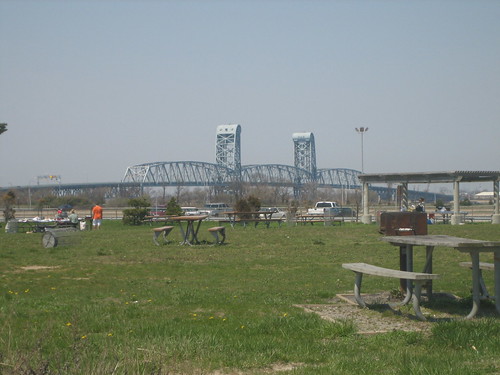
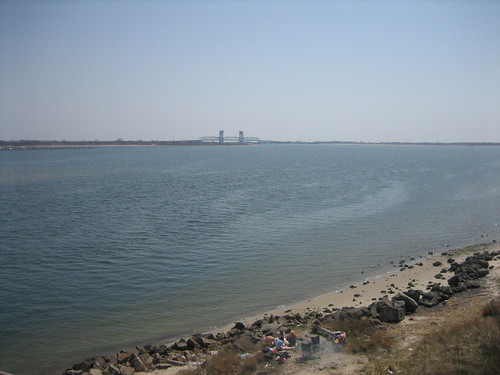
Seen in the distance from the Shore Parkway

The M.T.A. offered this historical tidbit in a news release commemorating the Bridge’s 70th Anniversary:

The morning of July 3, 1937, marked the grand opening of the new Marine Parkway Memorial Bridge. With the sun shining and the N.Y.P.D. Police Band ready to play, Mayor Fiorello H. La Guardia, Robert Moses, head of the Marine Parkway Authority and city Parks Commissioner and other officials, were getting ready to embark in a 500-car motorcade to christen the bridge.
There was excitement in the air as the band tuned up from its designated place on the bridge’s elevated lift span and invited guests got into cars on the Brooklyn side of the bridge along Flatbush Avenue for the inaugural ride across the span.
But the first vehicle to cross the bridge did not belong to the mayor or master builder Robert Moses, who helped make the bridge a reality. About 15 minutes before the ceremonies were scheduled to start, the first vehicles to cross the span were three engine companies from Brooklyn; summoned to help put out a five-alarm fire that destroyed two blocks of wooden concession stands along the Rockaway Beach Boardwalk.
Even before its official opening, the bridge proved it was an asset to the community. Mayor La Guardia pointed out that if the bridge wasn’t there, it would have taken the Brooklyn fire companies precious minutes to travel to the old Cross Bay Bridge, four miles to the east.
The Police Band, which scrambled off the lowered lift before the fire trucks screamed across the bridge, resumed their post and the ceremony went on as planned. A gun salute from nearby Fort Tilden announced the beginning of the event, which included a fireboat pumping streams of water into the air and a flyover by nine Martin bomber planes from nearby Mitchel Field.
Today, during the anniversary celebration, a Rockaway Point Volunteer Fire Department truck led the motorcade, the authority said, “in a nod to history.”

Quoted from the NY Times


IMG_2791

View of Coney Island with the Verrazano Narrows Bridge in the distance from the center span of the bridge.

Toll info Effective March 16, 2008

Cash $2.50

Token $1.67

E-Zpass $1.55

Rockaway Resident Token $1.40

Rockaway Resident E-Zpass $1.03


Toll Information from MTA info


Type of bridge: Vertical lift-span
Construction started: June 1, 1936
Opened to traffic: July 3, 1937
Length of main lift-truss span: 540 feet
Length of side truss spans: 540 feet
Total length of bridge and approaches: 4,022 feet
Number of traffic lanes: 4 lanes
Clearance at lift span above mean high water: 55 feet
Clearance at lift span in raised position: 150 feet
Steel used in through truss spans and towers: 7,600 tons
Steel used in deck truss spans: 3,800 tons
Concrete used in truss piers: 24,000 cubic yards
Concrete used in deck truss spans: 23,000 cubic yards
Cost of original structure: $12,170,000

Bridge Statistics from NYCRoads


View Larger Map