Only 2,021 more to go...
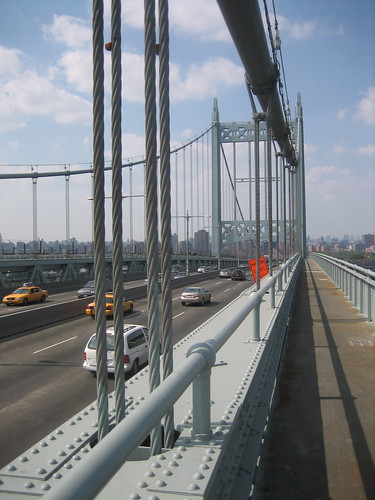
View of the pedestrian path on the East River section crossing from Astoria Queens to Randall's Island.
Spans Manhattan-Bronx-Queens, crossing Hell Gate (East River), The Harlem River, and the Bronx Kill.
The Triborough Bridge is a complex of three bridges connecting the three New York City boroughs of the Bronx, Manhattan, and Queens. The bridge uses what were originally two separate islands, Ward's Island and Randall's Island to support the center of the span.
The Robert Moses Building is the headquarters of M.T.A. Bridges and Tunnels, the successor to the old Triborough Bridge Authority. Robert Moses, the ultimate modern urban planner, kept his office at the center of his empire - on Randall's Island at the base of his biggest moneymaking bridge. Both the building and his office have been renovated over the years and no longer reflect the omnipotence of Moses at his peak.
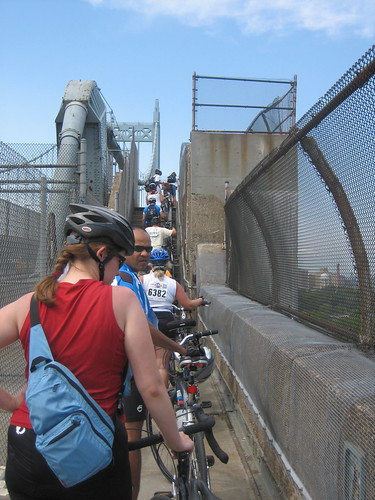
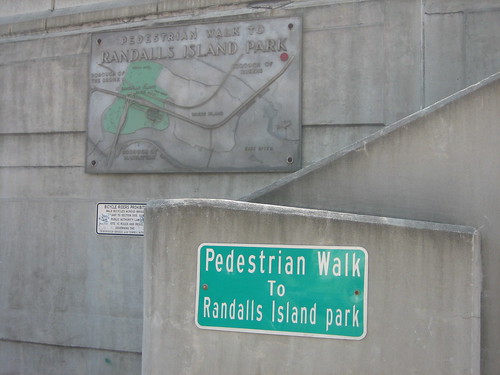
The Triborough does have a pedestrian path. It is mostly used by bicyclists who are legally required to dismount as they cross. Very few do so - until they run into one of the three staircases on the span. BEWARE.
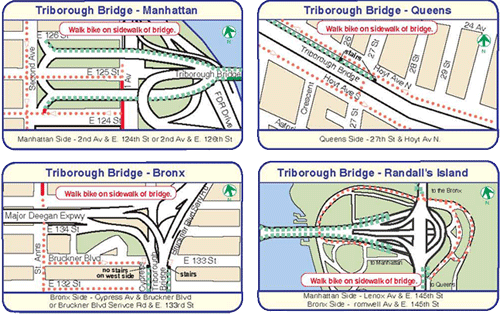
For those of you who have never crossed the Triboro by bike or foot, it can be very confusing. The DOT provides this map, but I get confused all the time, so here's a simple explanation.
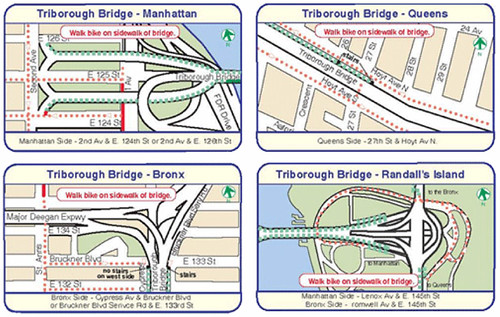
There is no direct route for cyclists and pedestrians from Queens to Manhattan or the Bronx. Instead of following the traffic, the path drops you on Randall's Island from all directions.
You need to cross the island and find the correct span for the borough you are going to, making the bridge a two-step process.
I haven't actually taken the Manhattan entrance this year, so I can't vouch for it, but if the ramps are open, they're at 124/126th and Second Avenue. If not, the stairs are at 124/126th and First Avenue.
Alternately, there's the Ward's Island Bridge at 103rd Street and the FDR, which is for bicyclists and pedestrians only. Ward's Island connects to Randall's Island.
The Queens entrance is the stairs at 27th and Hoyt.
The Bronx entrance is the ramp structure at 133rd and Cypress.
Here's a question that I never thought I'd ask, but in the context of this blog is sort of important. Is this one bridge or five?
Construction started: October 25, 1929
Opened to traffic: July 11, 1936
Total length of approaches (Manhattan-Queens-Bronx): 13,820 feet
Cost of original structure: $60,300,000
EAST RIVER SUSPENSION BRIDGE
Length of main span: 1,380 feet
Length of each side span: 700 feet
Length, anchorage to anchorage: 2,780 feet
Height of towers above mean high water: 315 feet
Clearance at center above mean high water: 143 feet
HARLEM RIVER LIFT BRIDGE
Length of main lift-truss span: 310 feet
Length of each side truss span: 230 feet
Length, anchorage to anchorage: 770 feet
Height of towers: 210 feet
Clearance of lift span above mean high water: 55 feet
Clearance of lift span in raised position: 135 feet
BRONX KILLS CROSSING
Length of main truss span: 383 feet
Length of approach truss span: 1,217 feet
Length, anchorage to anchorage: 1,600 feet
Clearance of truss span above mean high water: 55 feet
WARD'S ISLAND VIADUCT
Structural steel used: 29,500 tons
Reinforcing steel used: 5,500 tons
RANDALL'S ISLAND INTERCHANGE
Reinforcing steel used: 9,500 tons
Concrete used in roadway and piers: 111,200 cubic yards
Bridge Statistics from nycroads.com
View Larger Map
Thursday, September 27, 2007
The Triborough Bridge

Tuesday, September 25, 2007
The Verrazano - Narrows Bridge
Only 2,022 more to go...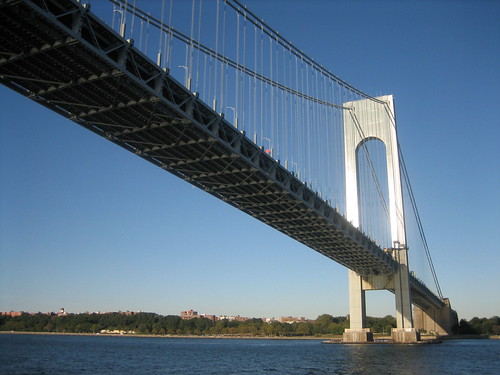
Spans - Brooklyn-Staten Island, The Narrows, New York Harbor.
According to the MTA, the Verrazano-Narrows Bridge was the world's longest suspension span when it opened in 1964.
"Its monumental 693 foot high towers are 1 5/8 inches farther apart at their tops than at their bases because the 4,260 foot distance between them made it necessary to compensate for the earth's curvature. Each tower weighs 27,000 tons and is held together with three million rivets and one million bolts. Seasonal contractions and expansions of the steel cables cause the double-decked roadway to be 12 feet lower in the summer than in the winter." (MTA website)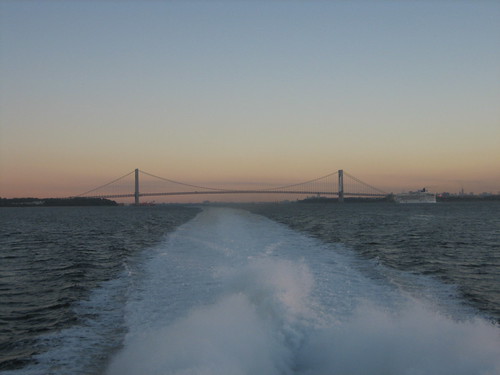
The Bridge at dawn as seen from the approach to New York Harbor
The bridge was designed by Othmar Ammann, who had also designed many of the most beautiful and iconic bridges in New York City, including the George Washington Bridge, the Bayonne Bridge, the Bronx Whitestone Bridge, the Triborough Bridge, Throgs Neck Bridge and the lovely, Hell Gate Bridge (AKA, The New York Connecting Railroad Bridge).
The dramatic silhouette of the span may be best known as the starting point for the annual NYC Marathon, but it is also featured in many films set in NYC. My personal favorite is from Saturday Night Fever when Tony Manero (John Travolta) and his Bay Ridge friends all get wasted and climb all over the cables.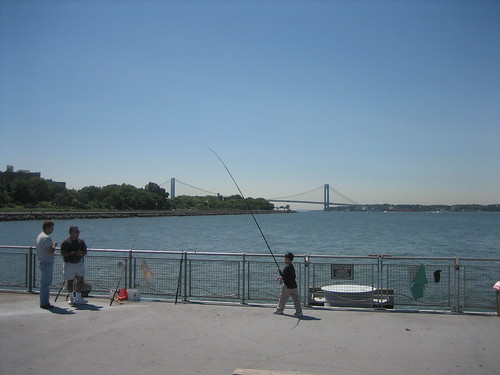
View from the 69th Street Pier, looking South to the mouth of the harbor.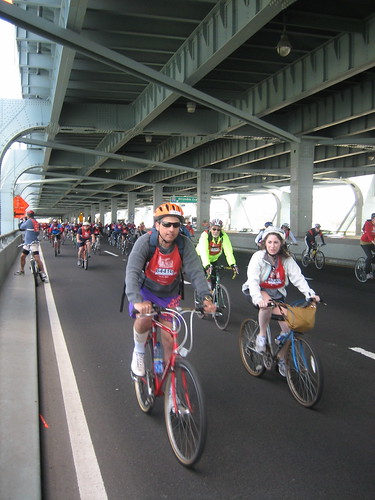
Crossing the span during the 2007, NYC 5Boro Bicycle Tour, one of the few opportunities for non-motorists to cross the bridge which has no provisions for pedestrians or bicyclists.
Type of bridge: Suspension
Construction started: August 13, 1959
Opened to traffic (upper deck): November 21, 1964
Opened to traffic (lower deck): June 28, 1969
Length of main span: 4,260 feet
Length of each side span: 1,215 feet
Length, anchorage to anchorage: 6,690 feet
Total length of bridge and approaches: 13,700 feet
Width of bridge: 103 feet
Number of decks: 2 decks
Number of traffic lanes: 12 lanes (6 upper, 6 lower)
Height of towers above mean high water: 693 feet
Clearance at center above mean high water: 228 feet
Deepest foundation below mean high water: 170 feet
Cost of original structure: $320,126,000
Bridge statistics from nycroads.com
View Larger Map
Saturday, September 22, 2007
The Macombs Dam Bridge
Only 2,023 more to go...
Spans - Manhattan-Bronx, Harlem River.
The bridge and adjoining park were named for the Macomb family who operated a dam and mill on the site.
As use of the Harlem River increased in the 1830's, the dam, which blocked all but the smallest of boats became a local bone of contention. In 1838, a group of local citizens rammed the dam with a coal barge and destroyed it by chopping through it with axes.
In the course of the following lawsuit and court case, the dam was found to be "a public nuisance..." built "without authority of law...the Legislature did not authorize the obstruction of the navigation of the river in the manner in which it was done by the dam in question."
After the Brooklyn and Washington Bridges, Macomb's Dam Bridge is the third oldest major bridge in New York City. It was designated a city landmark in 1992.
At the time of its construction, its massive steel central swing span was considered to be the world's heaviest movable mass.
Type of bridge: Moveable - Swing
Construction started: April 1, 1892
Opened to traffic: May 1, 1895
Length of main span: 412 feet
Length of two channels: 150 feet
Total length of bridge and approaches: 2,540 feet
Width of bridge: 60 feet
Width of roadway: 40 feet
Number of traffic lanes: 4 lanes
Clearance at center above mean high water: 28 feet
Foundation type: Caisson
Cost of original structure: $1,800,000
Bridge statistics from nycroads.com
The bridge is a handy way to access Yankee Stadium and can get fairly crowded before or after a home game in the Bronx.
View Larger Map
Friday, September 21, 2007
The Broadway Bridge
Only 2,024 more to go...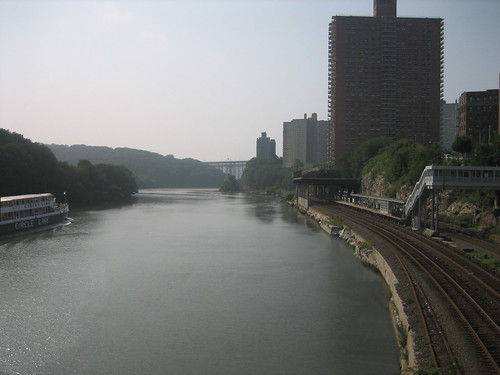
Spans - Manhattan-Bronx, Harlem River
View of the Harlem River from the Broadway Bridge.
This is more accurately the Harlem River Ship Channel as it is a man-made canal that was constructed in 1895.
The MTA, Marble Hill Station is in the foreground on the North side of the channel, the Circle Line is passing to the South, and the Henry Hudson Bridge is visible in the distance to the West.
Marble Hill is a truly strange example of NYC redistricting. The Harlem river originally passed to the North of the community, making it part of the island of Manhattan. When the channel was dug to facilitate the passing of larger ships, the area was cut off from the island, and the old river route filled in.
Marble Hill is still legally part of the borough of Manhattan.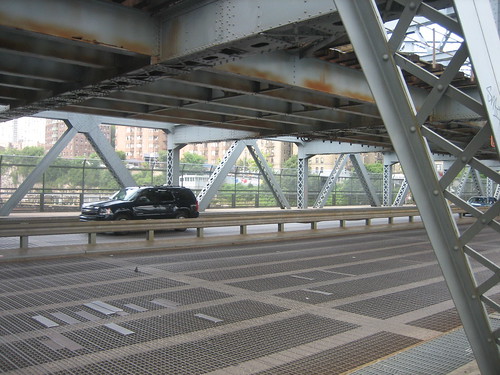
View of the actual bridge crossing.
The subway runs on the upper level.
Type of bridge: Moveable - Vertical lift
Construction started: April 1, 1959
Opened to rail traffic: December 26, 1960
Opened to vehicular traffic: July 1, 1962
Length of main span: 304 feet
Total length of bridge and approaches: 557 feet
Number of traffic lanes: 6 lanes
Number of subway tracks: 3 tracks
Clearance over mean high water (closed position): 25 feet
Clearance over mean high water (open position): 136 feet
Steel used in structure: 2,500 tons
Cost of original structure: $13,400,000
Bridge statistics from nycroads.com
View Larger Map
Thursday, September 20, 2007
Roosevelt Island Bridge
2,025 to go...
View of the Queensboro Bridge from the span of the Roosevelt Island Bridge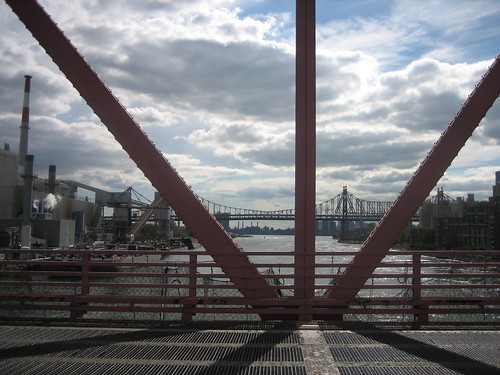
Spans - East River East Channel from Queens to Roosevelt Island
The bridge is the only motor vehicle connection to the island.
Other access is provided by a tramway from Manhattan and Subway service.
Type of bridge:Vertical lift
Construction started:March 17, 1952
Opened to traffic:May 18, 1955
Length of main lift span:418 feet
Total length of bridge and viaduct approaches:2,877 feet
Width of bridge:40 feet
Number of traffic lanes:2 lanes
Clearance over mean high water (closed position):40 feet
Clearance over mean high water (open position):100 feet
Height of towers:170 feet
Cost of original structure:$6,500,000
Statistics from nycroads.com
View Larger Map